PAP Group · · Fire alarm systems · Fire safety · 14 min read
The fire alarm system log book
The fire alarm system log book records the system’s maintenance, tests, alarms and modifications throughout its life cycle. This article explains what is recorded in the log book, who is responsible for it and how it is kept up to date.

What the log book contains
The log book is a record of all events and actions relating to the fire alarm system. The tests, verification inspections and monthly tests entered in the log book, with their dates and the names of those who carried them out, form the core of the log book. Every maintenance and inspection action must be entered in the log book with its basic details. More detailed maintenance and inspection reports on the condition of the system are kept as part of the system’s other documentation.
Alarm entries are another essential part of the log book. Every alarm is recorded, regardless of whether it was a real fire or an unwanted alarm. The entry includes the time, location and cause of the alarm and the actions taken. Documenting unwanted fire alarms makes it possible to identify shortcomings in the system, such as dirty or incorrectly positioned detectors, the wrong choice of detector type, or changes in the use of a space that call for, for example, replacing a smoke detector with a heat detector.
Modifications and extensions also require accurate documentation. If changes affecting the fire alarm system are made to the property, they are recorded in the log book. This includes installing new detectors, changes to the system programming and extensions. PAP Group handles the design, programming, commissioning and testing of systems, and all these actions are properly documented with an installation certificate and entered in the log book.
The legal basis of the log book
The Rescue Act 379/2011 and the decrees that supplement it set out the maintenance obligations for fire alarm systems. The Act requires the owner and occupier of a building to ensure that fire safety equipment and systems are kept in working order. This obligation covers both regular maintenance of the system and proper documentation.
The Act on Certain Fire Safety Equipment (191/2024) and the Decree of the Ministry of the Interior on Fire Alarm Systems and Automatic Fire Extinguishing Systems (976/2024) specify the maintenance requirements in more detail. Under the Act, an inspection body carries out a periodic inspection of a statutory fire alarm system every three years. Under the Decree, a service and maintenance programme must be drawn up for the system, and the service and maintenance work carried out must be recorded so that the information is available during servicing and periodic inspections. The log book is a key part of this documentation, and if it is missing or incomplete, questions of liability may arise in the event of damage.
Insurance companies are paying increasing attention to the documentation and maintenance of fire safety systems. Insurance compensation may be at risk if the property owner cannot show that the system has been properly maintained. A well-kept log book is the best evidence of careful maintenance and can speed up the processing of claims significantly.
Keeping the log book in practice
Keeping the log book requires a systematic approach and a clear division of responsibilities. The property owner is ultimately responsible for ensuring that the log book exists and is up to date, but the day-to-day upkeep can be delegated to the property manager or an external maintenance company. The most important thing is that responsibilities are clearly defined and all parties understand their roles.
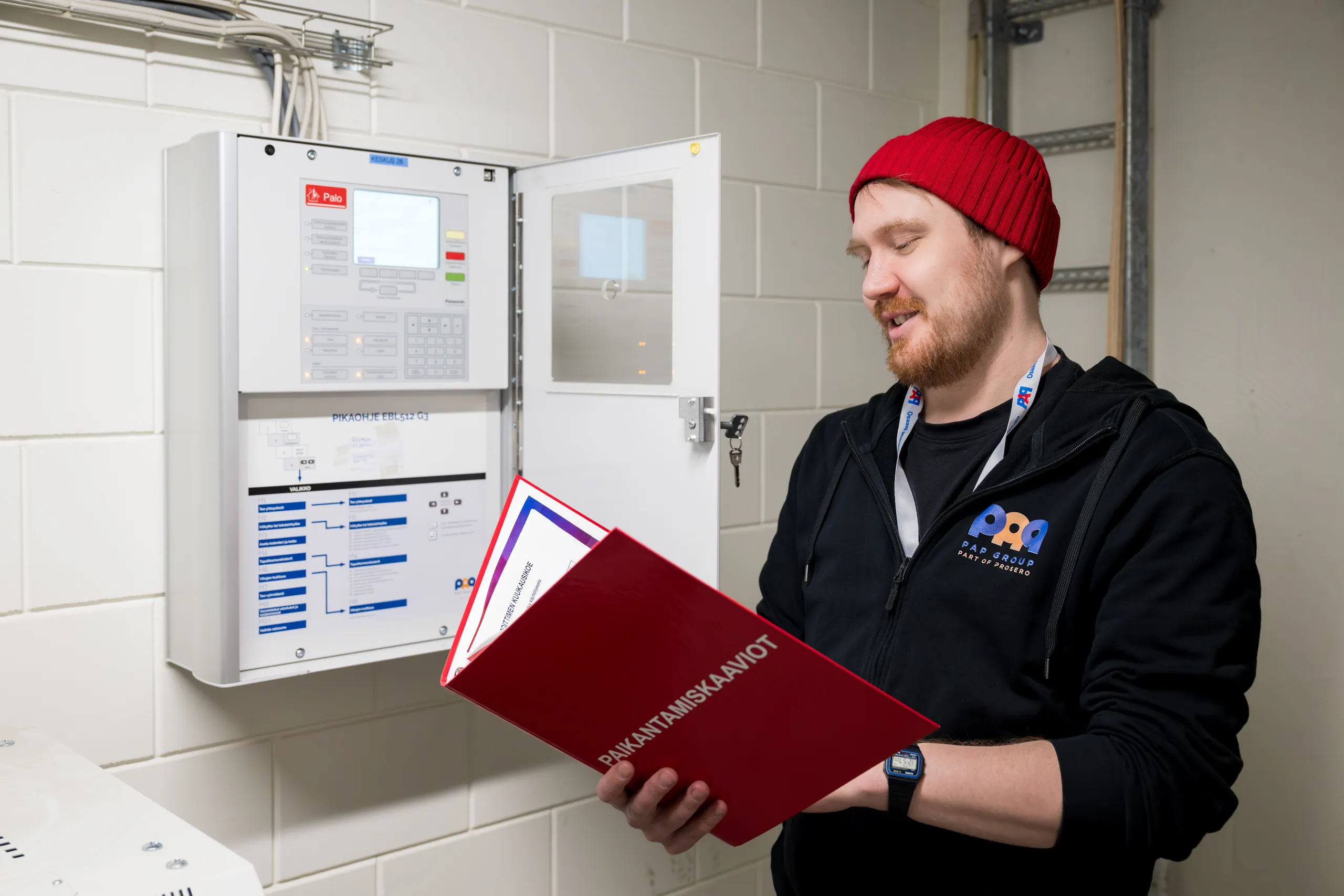
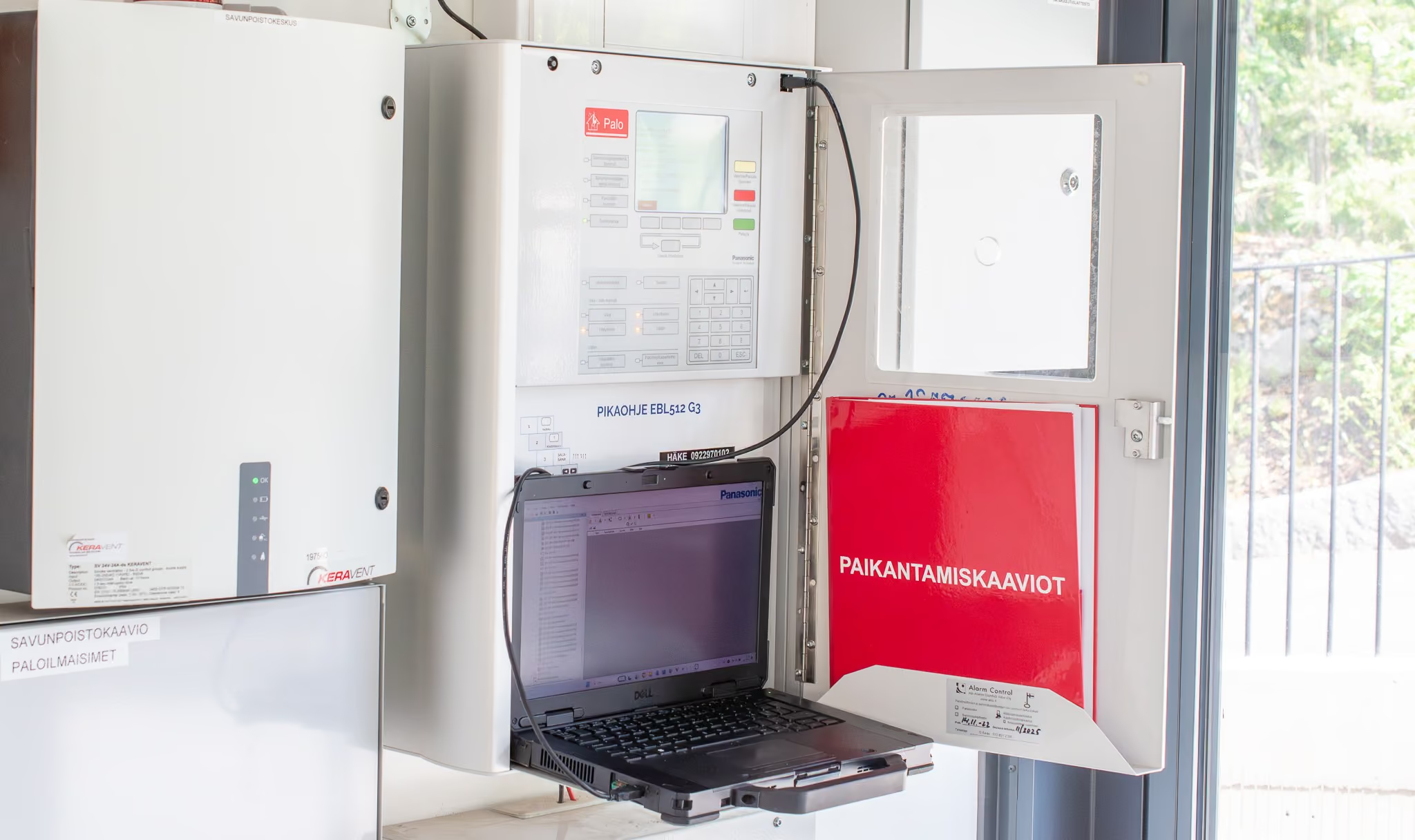
The traditional paper log book is still common, although electronic systems are becoming more widespread. A paper log book is usually kept close to the fire alarm control panel so that it is readily available for inspections and emergencies. Entries are made by hand, and each entry is signed. This traditional method is reliable, but it requires disciplined upkeep and regular checking.
Electronic log book systems offer many advantages over the traditional paper version, such as automatic backups and remote access. PAP Group uses a hybrid documentation model in all its maintenance work. Every maintenance visit is recorded accurately both in the paper log book and in PAP Group’s electronic equipment management system, the TIETO Tallelokero document vault. The customer receives clear information on the work carried out through both channels. This ensures that the log book stays up to date and meets all statutory requirements, and that more detailed reports on the work carried out are always available in TIETO Tallelokero. Professional documentation is part of a high-quality service that protects the property, its owners and its users alike.
Recording alarms and events
Every fire alarm and fault warning is documented in the log book, whether it was a real fire or an unwanted alarm. Careful recording and analysis of unwanted alarms help to identify recurring causes and repair needs. The alarm report records the exact time, the detector or zone that triggered the alarm and the probable cause of the alarm. In the case of an unwanted alarm, the aim is to establish the cause as precisely as possible. Common causes of unwanted alarms include dust, steam, humidity and dirty detectors. Documenting these causes helps to prevent future unwanted alarms.
The actions taken are also recorded accurately. The entry includes who responded to the alarm, what was done and what the outcome was. If changes were made to the system as a result of the alarm, such as moving or replacing a detector, this is also documented. This gives a clear picture of how alarms have been responded to and what was learned from the situation.
Under Decree 976/2024 of the Ministry of the Interior, the holder of a fire alarm system connected to the Emergency Response Centre or another monitored location must have the alarm transmission tested every month. This test ensures that the connection to the Emergency Response Centre (112) or another monitoring centre works. The test is usually carried out by the property’s fire alarm system custodian (paloilmoittimen hoitaja, the person designated by the site to look after the fire alarm system), and every test is recorded in the log book. PAP Group tests the transmission link during periodic maintenance, but the monthly tests are the responsibility of the property.
Documenting modifications and extensions
Modifications to a property can have a significant effect on the fire alarm system. Changes to the premises, new partition walls or a change in the use of a space may require the system to be updated. All such changes must be documented in the log book so that the system’s history remains clear and traceable.
Programming changes are often invisible, but they are just as important as physical changes. When the system’s logic or settings are changed, these changes are documented in the log book. This may include redefining fire zones, adjusting delay times, adding or removing detectors, adjusting algorithms or updating integrations with other systems. Professional programming and its documentation ensure that the system works optimally.
Storing the log book and keeping it accessible
The log book should be stored so that it is readily available when needed but at the same time protected from damage and unauthorised use.
A traditional paper log book is usually kept in a locked cabinet close to the fire alarm control panel. All relevant parties, such as property management, maintenance and the rescue authorities, should know where it is. The rescue authorities have the right to inspect the log book as part of their supervisory activities. The maintenance company must have access to the log book during maintenance visits. The property’s management and the people responsible for safety must also be able to consult the log book when necessary. Access to the log book should be clearly restricted to the people and parties who have a legitimate need for it, so that the information is available at the right time and securely.
Legislation does not specify an exact retention period, but in practice the documentation is often kept for the entire life cycle of the system. A long retention period helps to understand the long-term development of the system and any recurring problems.
The most common mistakes in keeping the log book
Incomplete documentation is the most common problem with fire alarm system log books. Maintenance may be carried out, but entries are not made or they are incomplete. Every maintenance visit, test and fire alarm or fault warning must be entered in the log book at the time, not afterwards from memory. Recording in real time ensures that the information is accurate and complete.
Unclear entries cause problems later. Short, vague entries such as “maintenance done” or “alarm” do not say enough. Each entry must contain sufficient detail for the reader to understand what was done, why and with what result. A reference to a more comprehensive work report is also a good idea, as it tells the reader where to find more detailed information about the work carried out.
Failing to follow up on problems that have been identified is a serious omission. If faults or shortcomings are found during maintenance but their repair is not followed up, the problems may remain unresolved. The log book must contain a clear entry showing when and how the shortcomings found were corrected. This follow-up chain is an important part of responsible maintenance.
Losing the log book or storing it poorly can cause significant problems. If the log book is lost or damaged, the entire maintenance history of the system is lost. That is why backups and careful storage are vital. Electronic systems reduce this risk, but they also require careful management and regular backups.
PAP Group’s role in keeping the log book and documentation
PAP Group understands the importance of the log book as part of comprehensive fire safety management. Every maintenance visit is documented systematically and professionally. The log book kept on site contains clear entries on the maintenance, inspections and work carried out on the system, and serves as a statutory document for the authorities.
More detailed maintenance and inspection reports, device-specific information and test documentation are stored in the TIETO Tallelokero document vault. TIETO Tallelokero serves as a centralised digital archive for the system, where up-to-date reports and device history can be found easily and reliably. The entries in the log book and the content of TIETO Tallelokero complement each other, forming a coherent and transparent body of documentation.
During maintenance visits, PAP Group’s trained technicians check that the log book is on site and its entries are current. The technician makes an entry for the maintenance work in the log book, and at the same time the maintenance reports are created directly in TIETO Tallelokero.
The programming, commissioning and testing of systems are documented with particular care. When PAP Group implements a new system or an extension, all technical information, settings and test reports are stored in TIETO Tallelokero. In this way, the system’s history is clearly documented from the outset and easy to use throughout its life cycle.
A long-term partnership with PAP Group ensures consistent, high-quality documentation year after year. The same maintenance company knows the history of the systems at the site and uses both the log book and TIETO Tallelokero to identify trends and potential risks at an early stage. This continuity supports both the upkeep of the log book and the reliability and safety of the system.
Frequently asked questions
How long must the log book be kept?
Rescue legislation does not set an exact retention period for the log book. For inspection reports, the Act on Certain Fire Safety Equipment (191/2024) sets minimum periods: the verification inspection report is kept for at least five years and the periodic inspection report at least until the next periodic inspection. In addition, the owner and occupier of the system must ensure that the fire alarm system is kept in working order and that all maintenance, testing and inspection work is properly documented. In practice, this means that the log book must be available throughout the service life of the system. According to the practice of the authorities and the industry, the documentation must make it possible to verify the system’s maintenance, modifications and servicing after the fact. Good practice is to keep the information even after the system has been taken out of use, in case questions of liability or investigations arise.
Who is responsible for keeping the log book?
Responsibility for ensuring that the log book exists and is up to date remains with the property owner, even though the day-to-day upkeep and the making of entries can be delegated to the property manager or an external maintenance company. According to the practice of the authorities and the industry, a clear written definition of responsibilities is essential so that the log book is kept systematically and verifiably. Maintenance companies such as PAP Group carefully document the maintenance and inspections they carry out and provide the customer with reports on them, which form a key part of the log book and the system’s life cycle documentation.
What happens if the log book is incomplete at an inspection by the authorities?
An incomplete or non-existent log book can lead to remarks or orders to remedy from the rescue authority. The authority may require the log book to be completed or the system to undergo additional inspections. In addition, in the event of damage, an incomplete log book can make it more difficult to obtain insurance compensation if the property owner cannot show that the system has been properly maintained. Checking the log book regularly and keeping it up to date is the best way to avoid these problems.
Can the log book be kept electronically?
Yes, the log book can be kept in electronic form, as legislation does not require a paper log book. The key point is that the documentation meets the requirements of fire safety regulations and is readily available, up to date and verifiable at inspections by the authorities. The electronic system must make it possible to present and print the information when necessary and ensure that the maintenance and inspection history remains unaltered throughout the life cycle of the system.
How often should entries be made in the log book?
An entry is made in the log book whenever an action or event affects the system. Periodic maintenance is recorded according to the maintenance interval, typically once a year. Every fire alarm or fault alarm is documented immediately after the event. The monthly alarm transmission tests are recorded regularly. Modifications and extensions are documented when they are carried out. Regular and consistent recording is the key to a well-kept log book. Entries should not be put off until later but made as soon as possible after the event to ensure accuracy.
Do unwanted alarms have to be recorded in the log book?
Yes, all fire alarms must be recorded in the log book, regardless of whether they are real or unwanted. Documenting unwanted fire alarms is particularly important because it helps to identify systematic problems. If a particular detector causes repeated unwanted alarms, this may indicate contamination, an incorrect location or another problem that needs to be fixed. Analysing unwanted alarms from the log book helps to improve the reliability of the system and reduce unnecessary alarms in future. Each entry must include the cause of the fire alarm and the actions taken.
Where can I get a new log book when the old one is full?
If the log book is full, a new one can be ordered directly from PAP Group. PAP supplies log books compatible with the Panasonic fire alarm control panels we import, intended to be kept with the fire alarm control panel for use by the authorities. The PAP log book is also a general-purpose design and can be used with other systems if desired. PAP Group can advise on changing the log book where needed and makes sure that documentation continues without interruption as part of the maintenance of the fire alarm system.
Contact us if you need a new log book for your site. You can order a log book using the order form, add it to a quote request from the product page or contact our sales team: myynti@pap.fi / +358 40 668 7641.
This article was produced as expert work by PAP Group with the help of artificial intelligence.