PAP Group · · Updated · Customer story · Fire alarm systems · 5 min read
High demands on fire safety at the Redi shopping centre
From a fire safety perspective, the Redi shopping centre is unique. It houses a wide range of different functions, and thousands of people visit or pass through it every day. That is why fire safety here has to be first-class.

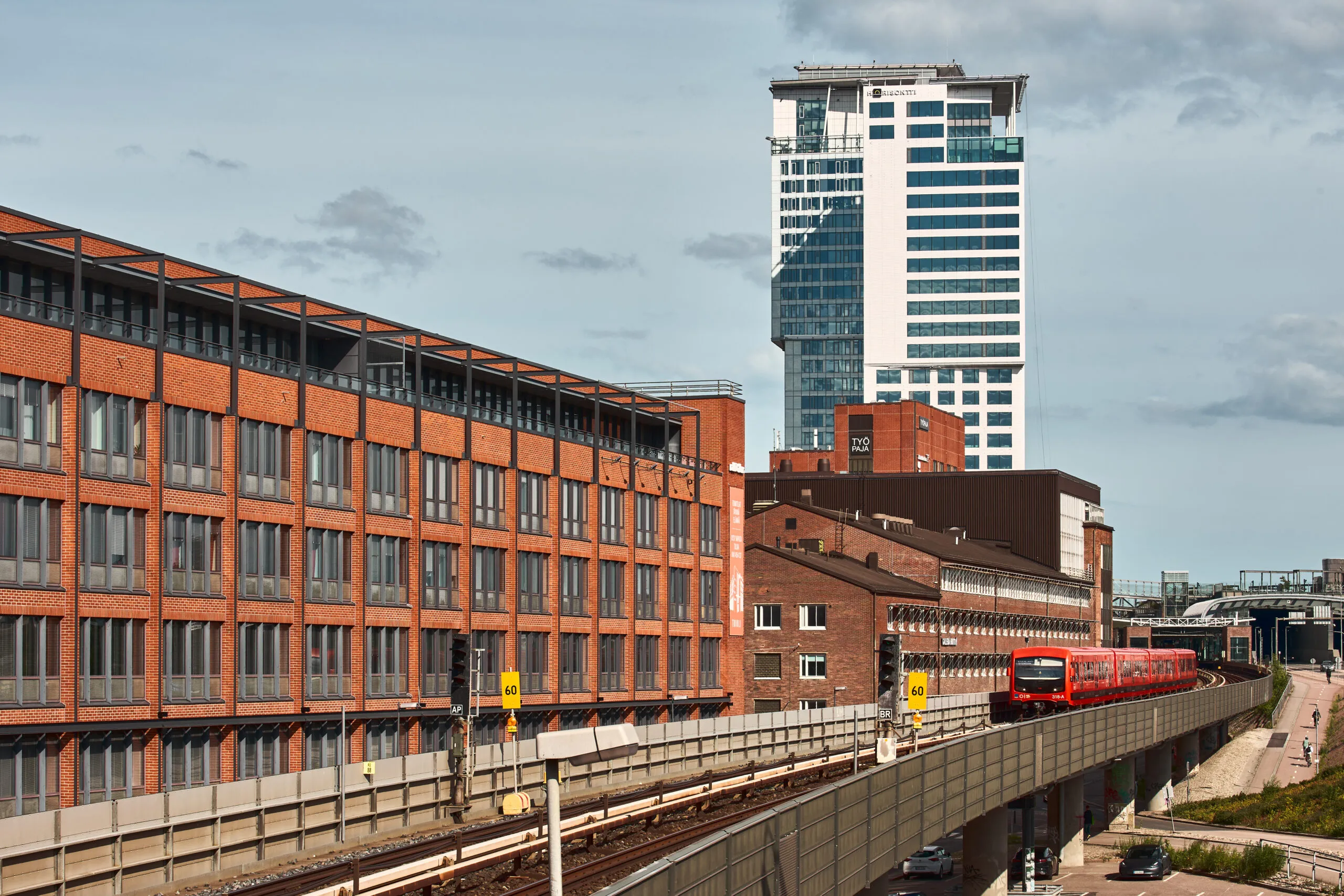
“Judging by its key figures, Redi is a rather impressive complex,” begins Jukka Parkatti, the shopping centre’s property director. “The site has 63,500 m² of lettable floor area, 120 shops, around 1,000 apartments and 1,950 parking spaces. The shopping centre has five storeys, the car park four, and the tallest of the four tower blocks 34. And that’s not all. New tower blocks are still being built around the shopping centre, which means hundreds of new apartments will be added to the Redi property complex in the coming years.”
Redi has unique details and functions not found in any other Finnish shopping centre. “On Redi’s roof there is a park the size of Helsinki’s Esplanadi. The property also has a climbing centre, an indoor skydiving wind tunnel and a cluster of circular economy businesses.”
In such a massive and diverse site, fire safety has to be in first-class condition. “The design and commissioning of the site’s fire safety solutions were carried out by PAP. It was important to us that the fire safety of our site was delivered by a skilled expert in the field.”
An extremely challenging site
Jukka Parkatti explains that fire safety for a property complex of this scale is not entirely straightforward. “There are around 10,000 fire detectors here alone, and 110,000 automation points controlling the fire system. The complex is so extensive that a great deal has been, and will continue to be, required of its delivery, maintenance and user training.”
For its fire safety, the Redi property complex received a fire alarm system and a voice alarm system designed and commissioned by PAP. “The emergency announcement system installed at the site is a modern way of guiding people in the event of an alarm. Clear instructions are important, especially because the site has a large number of occasional visitors every day. There is no way they can be naturally familiar with the shopping centre’s emergency exit routes, for example.”
PAP made some changes to Redi’s original fire safety design as the project progressed. In the car park access tunnels, an optical linear heat detection cable was installed instead of point detectors, and smarter fire detectors were installed in some areas. “In the car park access tunnels, the linear heat detection cable proved a smarter choice than the solution in the original design, because it was cheaper to install and will be easier to maintain in future. In addition, the fire detectors marked in the design have been upgraded to multi-sensor detectors in the shopping centre’s restaurant kitchens. Now the detectors do not react unnecessarily to steam from cooking, for example.”
As few unnecessary alarms as possible
Unnecessary fire alarms are costly at a site like Redi, which is why every effort has been made to minimise them and their knock-on effects. “Designing fire safety for our site was a challenge of its own, because in addition to the shopping centre itself, it contains many separate spaces. The fire system has to be smart enough that an alarm in the car park, for example, does not necessarily mean evacuating the entire shopping centre.”
Redi also uses a delayed fire alarm. “When a fire alarm is triggered, the security officers have one minute to press the delay button, after which they have 10 minutes to locate the cause of the alarm. Four out of five alarms can be acknowledged in this way, preventing the rescue department from turning out unnecessarily. With this function too, we are firmly at the forefront of fire safety, as to our knowledge nothing similar is in use at any other site in Helsinki, for example.”
Induction and maintenance as challenges
Staff turnover in a shopping centre is high, and that poses its own challenges for fire safety. “We have a lot of seasonal workers, which is why there is an ongoing need for induction training on how the systems work. Induction reduces the number of unnecessary alarms and ensures that staff know how to act correctly in the event of an alarm.”
The biggest challenge in Redi’s fire safety is maintaining the systems. “Our site is constantly evolving. The uses of the commercial premises change, and spaces are adapted to meet new needs. Fire safety must not be compromised despite the changes, and the fire systems have to be updated along with them. The party responsible for maintaining the systems therefore needs to understand them as a whole. PAP has up-to-date documentation of Redi’s systems as well as the expertise to carry out updates as the shopping centre changes.”
Life-cycle costs under the microscope
Especially in the construction industry, price is often the deciding factor when choosing contractors or solutions. Nobody really keeps track of how economical the cheapest solution at the time of purchase ultimately turns out to be in the longer run.
Jukka Parkatti challenges this way of thinking. “A property owner should be extremely interested in what the bottom line looks like over a long period, say ten years. The winner of the price competition at the time of purchase can often be something that needs constant repairs along the way and ends up being rather expensive. When Redi’s fire safety systems were chosen, their life-cycle costs were considered. Because the site is constantly evolving, the systems have to be cost-effective to update and maintain over the long term.”
According to Jukka Parkatti, PAP’s services are worth turning to precisely when the reliable operation of a fire system and its costs over its entire life cycle matter. “PAP designs and delivers fire safety solutions that are smart in terms of total cost, and they have experience of large and demanding sites. In my experience, PAP’s experts are reliable professionals in their field who know what they are talking about and what they are doing.”
Article photo: Janne Hirvonen